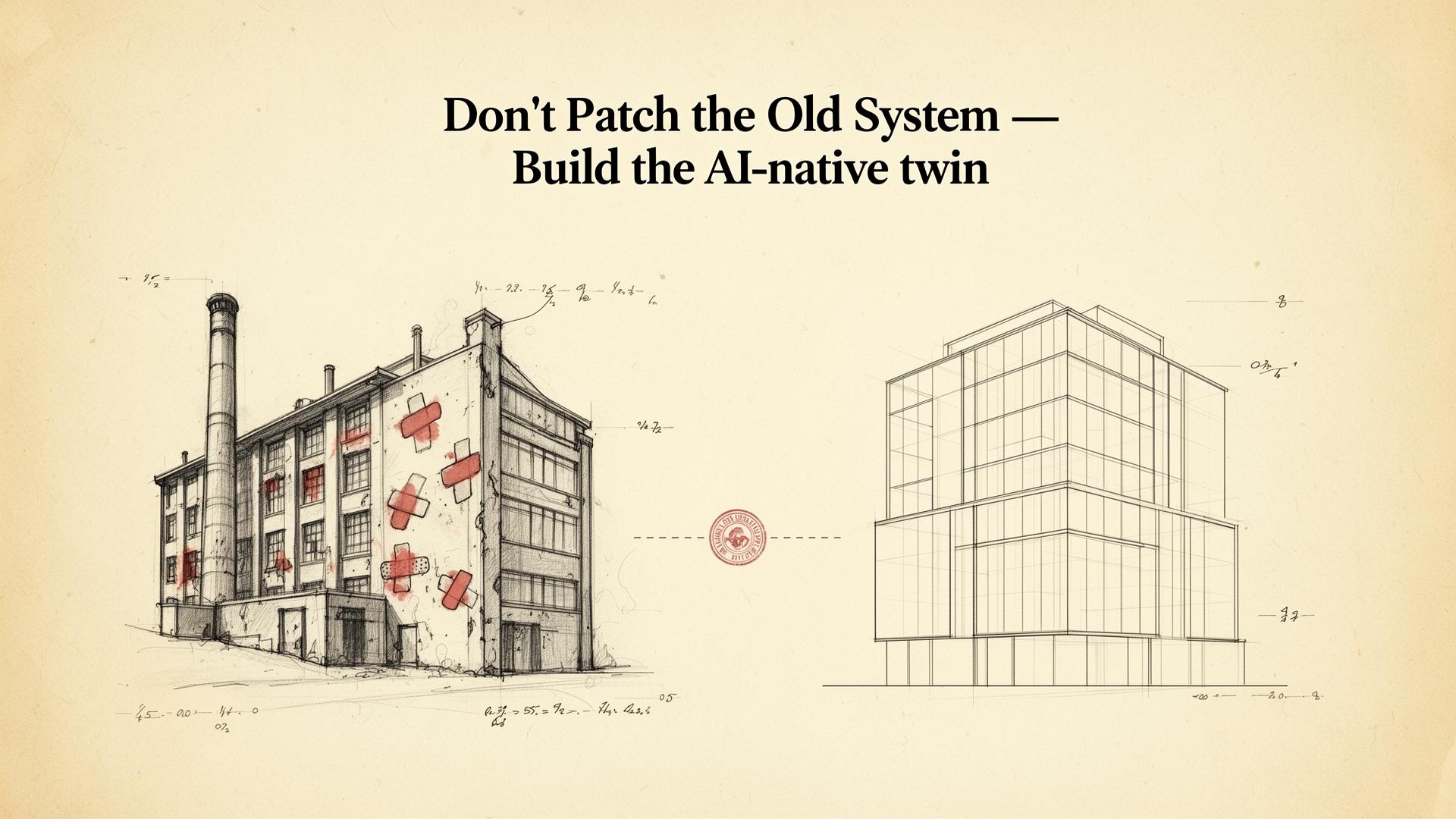
The real decision
There is a quiet decision being made inside many companies right now.
The decision is not:
"Should we adopt AI?"
That question is almost over. Most companies have already answered yes.
The real decision is:
Are we improving the old company with AI — or are we building the AI-native version of the company next to it?
These are not the same project.
They require different economics. Different talent. Different metrics. Different decision rights. Different definitions of what "good" looks like.
But on most roadmaps, both show up under the same label: "AI initiatives."
That is where the confusion starts.
Productivity is not transformation
Most AI work inside companies starts at the productivity layer.
Add AI to the CRM. Add AI to support tickets. Give everyone ChatGPT. Automate reports. Help teams write faster.
Useful? Yes. Transformational? Rarely.
A CRM with AI features is not the same thing as an AI-native revenue system.
A marketing team using AI to write faster is not the same thing as an AI-native growth engine.
A support team with a chatbot is not the same thing as a redesigned customer resolution model.
One improves the old workflow. The other makes the old workflow less relevant.
Some existing processes should not be improved. They should disappear.
What I learned from AI labs
I learned this in a very practical way while trying to move a development team toward a higher level of AI maturity.
At first, the idea looked simple:
Create AI labs. Give people space to experiment. Build small internal tools. Share what works. Move from casual tool usage into deeper workflow integration.
And some of it worked. People generated useful ideas. Knowledge started moving across the team. Small improvements appeared. The energy was real.
But then I saw the hidden cost.
The "AI transformation initiative" quietly became another set of projects to manage. Someone had to organize the labs. Follow up on experiments. Push unfinished ideas to completion. Translate experiments into actual workflow changes. Create adoption pressure. Connect the new tools to the real delivery process.
For a small team already operating at 100% capacity, this was not a 20% innovation time model.
It was closer to:
100% delivery + transformation load.
That distinction matters. AI transformation is often presented as something teams can do on the side. But real transformation requires people to change how they work while still delivering the current business.
That is not a side project. It is a second operating load.
The real jump is not tools
The deeper we went, the clearer the real challenge became. The issue was not just "learning AI tools."
The maturity jump required a different way of working:
More specification-driven development. Clearer quality gates. QA moving from checking the result to shaping parts of the quality system. Developers thinking less like task executors and more like workflow architects. Product and engineering working with more explicit definitions of intent, acceptance, and automation boundaries.
That is not tool adoption. That is capability transformation.
And capability transformation is hard because people are not just changing tools. They are changing professional identity.
Where AI transformation really breaks
If you trace the failures honestly, the bottleneck is rarely talent and rarely tools.
It is the decision-making layer at the top of the company.
Most large organizations have a decision system built to protect the current business. Approval chains. Capital allocation. Performance metrics. Executive reviews. Risk controls. All calibrated to one operating logic.
When you ask that system to also build a competitor of itself inside its own walls, it struggles. Not because leaders are weak. Because the system is doing the job it was designed to do.
Tools live at one level. Workflows live a level above that. Org design above that. And the conflict between the old company and the AI-native twin lives one level higher again — where the company decides what it actually is.
You cannot resolve that conflict with tools, no matter how good they are.
The answer is not either / or
"Improve the old company or build the AI-native twin" sounds like a strategic choice. But the better answer is structural.
The old company remains the host. It pays the bills. It protects the current business. It supplies customers, distribution, context, and operating muscle.
The AI-native twin runs differently. Different workflows. Different metrics. Different decision rights. Different talent density. Different cadence.
The synthesis is not rhetorical. It is structural. The old company funds the twin. The twin learns faster. The decision system holds both.
The product opportunity: TransformOS
If this problem is real, companies will need a new kind of management layer.
Not another AI tool directory. Not another project tracker. Not another governance checklist.
They will need a control system for AI transformation. A system that helps leadership see what to improve, what to redesign, and what to rebuild.
That is the product opportunity behind TransformOS — a control layer for managing AI transformation across workflows, teams, maturity levels, initiatives, governance, and operating models.
One question
The next competitive advantage will not be AI adoption. Adoption will become table stakes.
The advantage will go to companies that can answer a harder question:
Where do we improve the old system, where do we redesign the workflow, and where do we build the new operating model from scratch?
That question cannot be solved by tools alone. It lives in the decision system of the company. And in most cases, that decision system is the real bottleneck.
Get the next plate in your inbox.
One strategic memo or weekend-buildable AI product idea per week. No noise. Confirm your email to activate the subscription.
Working on AI transformation?
If you are building, managing, or advising AI transformation inside a company, I'd love to compare notes.
Where does it break for you — tools, workflows, org design, or decision-making?