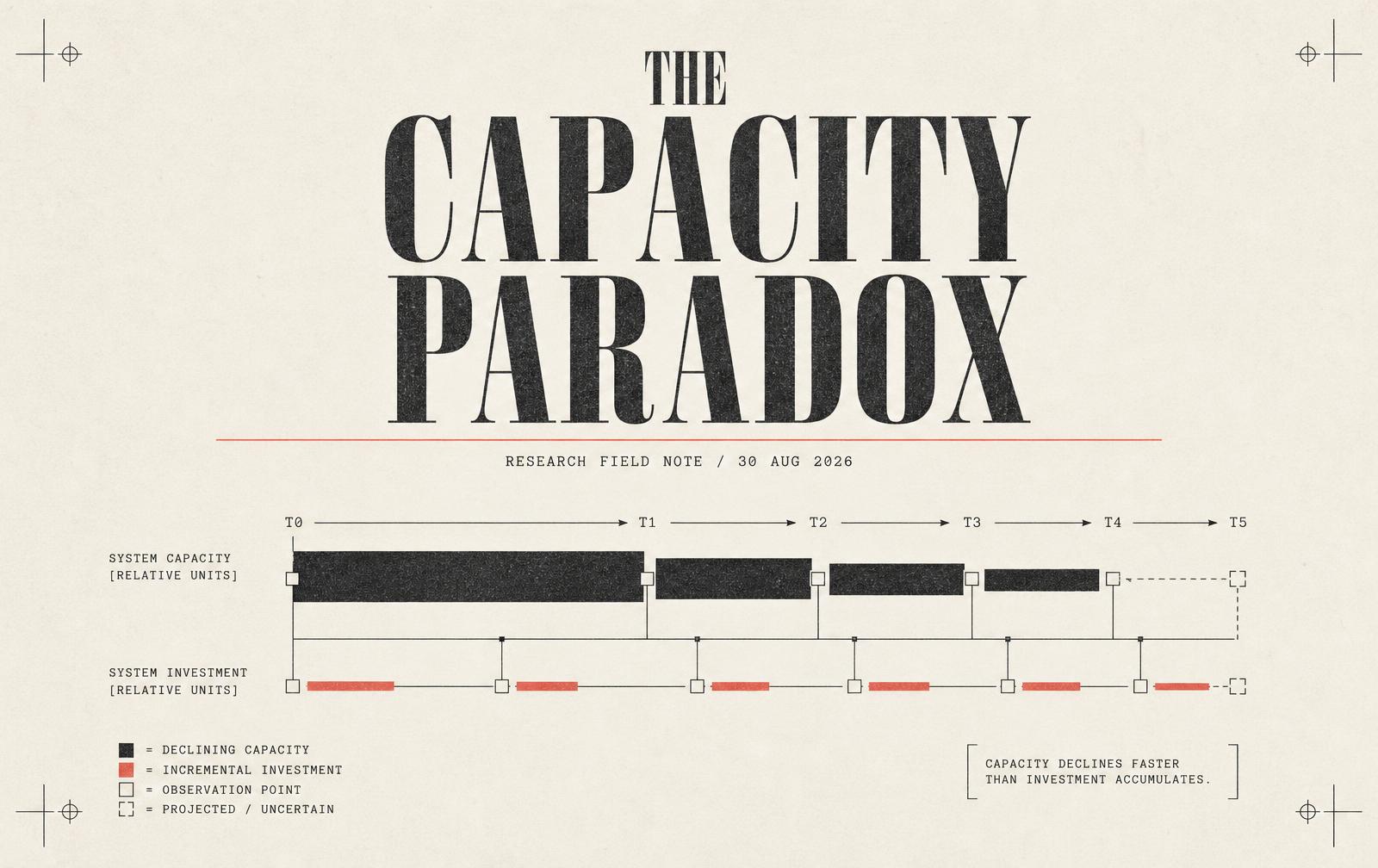
I was looking for weak execution. I found an invisible resource.
This did not start with a product idea. It started with a practical observation that kept repeating. Across years of transformation projects I kept seeing the same strange situation. On the slide everything was coherent: strategy approved, owner appointed, roadmap in place, status green. Inside the process, people routed around the rules, data disagreed with itself, key decisions hung, and the consultant saw only the version of the organization someone had time to show.
So I started collecting recurring pains from research and from practice: too many parallel initiatives, change fatigue, unavailable key people, weak sponsorship, unready data, pilots that never scale, poor prioritization, and the gap between projected and realized value.
At first it looked like the familiar catalogue of failure causes. But once I connected symptoms, pains, mechanisms, and constraints into a single ontological map, a more interesting pattern appeared: many of these problems are not independent. They occur because the company does not see — and does not protect — a few critical capacities required to change itself.
That difference rarely becomes a managed object. A company measures revenue, cost, utilization, delivery, adoption, and ROI. It almost never measures how much real capacity is left in the people and the nodes that are supposed to rethink processes, learn new ways of working, and run hundreds of interconnected changes.
Operational capacity is the ability to sustain the current system and keep today's promises. Transformation capacity is the ability to rebuild the system without destroying it before the new loop of work exists.
The company cuts the resource — and loses the ability to change
Picture a person who understands that in two years their current profession may not exist. To hold their place in the market they need a new, significantly harder qualification. That means several hours of intense study every day — and finishing earlier than the other candidates competing for a limited number of new positions.
The rational strategy is to free part of the working week, find a strong program, and protect the resource for the transition. And precisely at that moment a colleague quits. The person takes the extra load, works 12–14 hours, studies in the evenings and on weekends — whenever strength is left — and soon drops out.
The same thing may be happening to companies right now. To fund AI they cut people, freeze hiring, and add new initiatives to existing teams. But the operational work does not disappear. It is redistributed to managers, domain experts, and the strongest employees — exactly the people who are supposed to design the new processes and carry the change.
Operational capacity drops, transformation capacity never appears. The company tries to free the resource for change by destroying the resource change requires.
AI use keeps widening. Systemic effect stays rare.
Studies of different segments do not converge on one universal number, and that limit matters. Official statistics on all SMEs, surveys of the technologically active middle market, and global samples of large companies measure different things. But the direction of the signal is stable: AI usage grows faster than its integration into core operations and faster than measurable effect.
74% of companies showed no tangible value; 22% moved past PoC; 4% created substantial value.
The problem is not access to a model. It is the ability to scale a change.
Only 21% of gen-AI users reported a fundamental redesign of at least part of a workflow — and redesign correlates most strongly with EBIT impact.
Value appears after the work is rebuilt, not after the tool is added.
91% of middle-market organizations used gen AI, but only 25% called it fully integrated; 92% hit difficulties.
High adoption is not mature operational integration.
At least half of GenAI projects were stopped after PoC — data quality, risk controls, cost, or unclear value.
Prerequisites and value logic have to be tested before build.
SMEs lack AI-ready data, skills, capital, capacity, and the ability to connect AI to tasks and outcomes.
SMBs need a light, service-assisted transformation loop.
These percentages cannot be added or compared as one sample. Together they show the gap between using AI, redesigning workflows, and realizing value. RAND, after 65 interviews with experienced data scientists and engineers, named wrong problem framing, missing data, chasing a fashionable technology instead of a real problem, and mismatch with business context among the leading causes of failure. That supports the central claim of the Atlas: a poor model of current activity makes even a technically successful AI project strategically wrong.
Transformation Atlas: not a list of problems, a causal model
The map is built as a graph in which you cannot jump from symptom to solution without paying for it. Every conclusion is stored as a separate object and carries a type, an evidence level, sources, related hypotheses, product opportunities, and a verification method.
Objects are separately marked CONFIRMED, SUPPORTED, DERIVED, HYPOTHESIS, or FIELD SIGNAL. This protects the map from the usual error: a practical observation may launch research, but it must not silently become a proven universal law.
Walk the map
Below is the Atlas in use: opening a node, reading its confidence, its evidence, and the causes underneath it. Each object states plainly whether it is an established finding or the author's hypothesis — and what would have to be true for it to hold.
Five candidate root constraints
The bottom layer of the Atlas holds five candidates. Three of them — truth capacity, ownership capacity, and execution readiness — carry stronger support. Two are still hypotheses that need field verification.
Transformation Capacity
Transformation ambition can exceed the company's real ability to run change.
Research supports the shortage of time, skills, capital, and key people well. What the market does not yet offer is an accepted metric that shows transformation capacity as a separate managed object. The dangerous part: the capacity of critical nodes is usually assumed, not verified. A new initiative enters the portfolio, but the owner's calendar, the weight of their current responsibility, their right to stop work, and the availability of domain experts stay outside the business case.
- —Initiatives grow faster than the protected capacity of key owners.
- —Headcount cuts push operational load onto exactly the people transformation needs.
- —Learning and redesign become extra work after the real work.
- —The next bottleneck appears right after a local improvement and absorbs the gain.
Truth Capacity
A company can automate not its real process, but the official representation of it.
Truth capacity is the ability to detect, safely escalate, and use uncomfortable operational truth. It is not a moral property of people. It is an architecture of signals, incentives, evidence, and leadership reaction. Organizational silence research shows employees withhold information when speaking up feels dangerous or pointless; in Milliken, Morrison and Hewlin's study most of the 40 interviewees recalled a time they did not raise an important issue. For an external consultant there is a second trap: the baseline is built from interviews and curated artifacts controlled by the same people whose work the system is supposed to assess.
- —Bad news is delayed or softened — the mum effect.
- —The green-status incentive rewards predictability over early escalation.
- —Process-as-designed diverges from process-as-done.
- —After a failure, blame moves to data, people, or technology without revising the baseline.
Change Ownership Capacity
The named owner may not hold the authority, time, and resource that real ownership requires.
Ownership is usually described as a motivation problem — "the executive is not engaged enough". The more operational explanation is that the owner cannot make critical decisions, cannot remove conflicting load, cannot get the right people, and is accountable for an outcome that sits between several functions. Prosci reports a sharp gap in goal achievement between initiatives with extremely effective and extremely ineffective sponsorship: 79% versus 27%. That does not prove single causality, but it does confirm sponsorship is a production function of change, not a ceremonial one.
- —The owner is accountable for the outcome but does not control the prerequisites.
- —Critical decisions are spread across business, IT, data, security, and finance.
- —Escalation becomes negotiation with no predefined decision path.
- —The owner's time is consumed by operational meetings and other initiatives.
Execution Readiness
Process, data, roles, integrations, training, security, and governance form a single dependency chain.
Organizations assess readiness in fragments. The data team checks data, IT checks integrations, security checks risk, the business checks benefit. But a project only passes when the whole prerequisite chain is closed. A fast start on build can be the slowest route to value: an open dependency is discovered after the prototype, triggers rework, moves dates, and destroys trust in the use case. Automating an unverified process is worse than slow — locally it cuts operation time while spreading wrong rules, exceptions, and workarounds faster across the value chain.
- —Readiness scores exist separately and never form a dependency graph.
- —Governance and privacy join after the PoC.
- —Training and role change are planned after technical launch.
- —There is no baseline and no owner for the realized-value metric.
Culture as an Amplifier
Culture matters, but it is far too aggregated to be a useful single root cause.
"The culture isn't ready" explains almost everything, which is exactly why it manages almost nothing. It blends incentives, power, escalation safety, error response, decision style, and evidence quality into one word — and slides easily into blaming employees. In the Atlas, culture is treated as a reinforcing system: produced by leadership behaviour and formal mechanisms, then amplifying weak truth capacity, ownership, and readiness. This changes the practical question. Instead of "how do we change culture?": what happens to the person who brings bad news; what status does a project without evidence get; who benefits from keeping the narrative green; which decisions may the owner actually make; how much time is protected for change.
- —Psychological and career risk suppresses upward voice.
- —Status optimism creates a false baseline.
- —Defensive attribution preserves the original model after failure.
- —Leader behaviour turns local reactions into a repeatable norm.
Why one successful AI project is not enough
The theory of constraints reminds us that at any moment one main bottleneck limits the output of the system. AI transformation adds a second problem: the next constraint is often too close.
Say AI halves the handling time of an incoming order. If data validation, pricing approval, inventory reconciliation, or a manager's decision is already running at the limit, accelerating the first stretch only builds a queue faster at the second. A local KPI improves; the north-star metric and the end-to-end value flow barely move.
Explosive productivity does not come from one hero use case. It appears as the cumulative effect of a sequence of interconnected redesign decisions: process, data, roles, decision rights, incentives, training, interfaces, and measurement. Not necessarily all at once — but in the right order, with continuous detection of the next constraint.
How to measure something that has no single metric yet
I could not find an accepted metric for transformation capacity. That does not mean the object cannot be measured. Early on, a set of proxies tied to concrete mechanisms is more useful than one beautiful maturity score.
Whether the transformation resource exists outside the plan.
The gap between narrative and operational truth.
Formal ownership separated from real ownership.
Readiness to build and deploy.
How fast bad news travels.
Wrong diagnosis translated into economic damage.
These indicators are still a working model. Their value should be judged not by the beauty of a dashboard, but by whether they detect rework earlier, change a priority, stop an unprepared build, or defend a realistic resource in front of the CEO.
The first transformation project may contain no AI at all
If the root constraint turns out to be the capacity of a critical node, starting with another pilot is pointless. First you have to create a subject capable of running the change.
If logistics is being rebuilt, the function head may need 50% protected time, a deputy for operational work, half as many meetings, the removal of some strategic initiatives, and an immersion program in process mining, AI tooling, and best practice.
Sometimes this means temporarily hiring more people — an assistant, an analyst, an operations coordinator, extra doers — instead of cutting immediately. It looks like a drop in short-term efficiency. In fact it buys an option on a new system.
AI is useful here too, in a different role. Small internal apps, learning programs, analytical copilots, and evidence-collection tools can quickly cut the cost of preparing the node — before the company moves on to harder automation of core workflows.
What Transformation Atlas does
The Atlas is a research and diagnostic layer. It does not try to instantly hand over "the best AI use case". Its job is to preserve the causal structure of the problem and stop the organization from losing the line between a fact, a derived conclusion, and a hypothesis.
- Connects pains, mechanisms, root constraints, evidence, metrics, and product opportunities.
- Shows separate cuts for SMB and enterprise.
- Stores the confidence level and the limits of every source.
- Lets you drop from a symptom into a causal chain and back out to a testable intervention.
- Displays existing products and the uncovered parts of the market.
- Stays a mutable map, not a final static report.
Even in this form the Atlas creates value as a thinking instrument: it forces a split between a confirmed pain and an authored hypothesis, makes a missing management object visible, and requires you to state what exactly should change in the CEO's decision.
From Atlas to Transformation OS
The next product hypothesis is to turn the map from a research artifact into a control layer for AI transformation. Not a replacement for Jira, ClickUp, or ERP — a system that holds organizational truth, readiness, sequencing, and realized value on top of the existing systems of work.
The market is not empty — and that is what makes the niche visible
Use Case Foundry, SilkFlo, Softura PULSE, Gartner AI Use Case Insights, Governara, AI-TOS, and TowerIQ cover parts of discovery, use-case portfolio, business case, governance, and value tracking. SAP Signavio builds process truth from transaction logs. Planview, Shibumi, and Atlassian connect strategy, portfolio, and execution.
The uncovered zone is not the absence of yet another use-case catalogue. It sits between company-specific diagnosis, an organizational capacity model, a prerequisite dependency graph, an evidence chain, and continuous control of implementation.
But a gap on a map is not yet a market. It becomes a product opportunity only when it regularly changes top priorities, prevents rework, reduces the cost of managing the portfolio, or creates willingness to pay.
What has to be proven next
- Review 8–12 SMB transformation cases: successful, stopped, and stuck at pilot.
- For one process, collect independent layers: official status, interviews, workflow artifacts, and transaction/system evidence.
- Mark material claims as supported, contradicted, unsupported, or stale, and compute Status–Evidence Divergence.
- Compare an AI use-case shortlist before and after evidence triangulation: did the top three priorities change?
- Test whether authority and protected capacity explain weak ownership better than generic "motivation".
- Record whether the system finds a materially important gap before the team does, and prevents at least one rework cycle.
- Test willingness to pay through a paid diagnostic or procurement commitment — not interest in the map.
The main constraint may not be where it is being looked for
A shortage of time and skills is the usual named root cause of AI failure. But time and skills can be bought — if the company sees where they are needed, what result they protect, and what risk they prevent.
The deeper constraint is not-seeing. The company does not see its own ability to change; does not know how far its official narrative has drifted from reality; does not distinguish an appointed owner from a subject with real rights and capacity; does not connect readiness into a single dependency chain.
Which is why the first step of AI transformation can look surprisingly non-digital: stop an initiative, clear a calendar, hire an assistant, protect a piece of bad news, re-verify a baseline, or give an owner the right to make an unpleasant decision.
Companies may have to sacrifice part of their short-term operational capacity in order to build transformation capacity — and only then obtain a completely different performance of the whole system.
Transformation Atlas is an attempt to make that hidden system visible. Not to finish the answer, but to give a company an object it can argue with, verify, and use to make more defensible decisions.
Snapshot: 29–30 August 2026. The studies use different definitions of AI adoption, company size, and success. Survey- and interview-based data support mechanisms but do not prove single causality. Competitor capabilities are based on public positioning and do not replace demos, trials, and customer reference calls.
- 01McKinsey — The State of AI: How Organizations Are Rewiring to Capture Value
- 02BCG — Where's the Value in AI?
- 03RSM Canada — Middle Market AI Survey 2025
- 04Gartner — Why 50% of GenAI Projects Fail
- 05ISED / G7 — SME AI Adoption Blueprint
- 06RAND — The Root Causes of Failure for Artificial Intelligence Projects
- 07Morrison & Milliken — Organizational Silence
- 08Milliken, Morrison & Hewlin — An Exploratory Study of Employee Silence
- 09Snow, Keil & Wallace — Optimistic and Pessimistic Biasing in Project Status Reporting
- 10Prosci — Change Management Success / Sponsor Effectiveness
Get the next plate in your inbox.
One strategic memo or weekend-buildable AI product idea per week. No noise. Confirm your email to activate the subscription.
Working on AI transformation?
If you are building, managing, or advising AI transformation inside a company, I'd love to compare notes.
Where does it break for you — tools, workflows, org design, or decision-making?